
Beyond the University: Towards Transfer
Author Details Niamh Fortune, Froebel Department of Primary and Early Childhood, Maynooth University, Ireland; Ryan Dippre, Department of English, University of Maine, United States; Lucie Dvorakova, School of Physics and Astronomy, University of Edinburgh, United Kingdom; Alison Farrell, Centre for Teaching and Learning, Maynooth University, Ireland; Melissa Weresh, Law School, Drake University, United States; Nadya Yakovchuk, Doctoral College, University of Surrey, United Kingdom
Corresponding Author Niamh Fortune

Abstract
This chapter explores students’ experience of transfer as a worked example of our assertion that a deliberate focus on transfer of learning beyond the university could be part of the new normal for higher education and could contribute to student success. Specifically, the article examines how students experience writing transfer beyond the university using a portion of the data which we gathered as part of a Froebel Department of Primary and Early Childhood Education Maynooth University case study on this topic, which was in turn part of a large international multi-institutional study on writing beyond the university (Elon University, Writing Beyond the University Research Seminar); the case study in full is reported in Writing Beyond the University: Preparing Lifelong Learners for Lifewide Writing. The purpose of our research was to explore how student writers make connections and navigate transitions between academic setting writing (writing done in the University) and writing beyond the university in professional settings. In order to answer this question, we worked with a group of 4th year undergraduate students (n 60) who completed a questionnaire pre- and post-professional placement. We mapped students’ experience of writing transfer beyond the university using an activity theory framework for understanding transfer and our findings. We suggest implications of the findings, which we believe could have applicability beyond writing to curriculum design, assessment, workplace readiness, employability and student success.
Keywords Transfer, Academic Writing, Writing Beyond the University (WBU), Student Success, Placement
Introduction
The recently published National Forum Insight entitled Towards a National Understanding of Student Success (2019) notes that the path to that national understanding was taken through a review of national policy, of institutional strategies and of scholarship in the field. It was also informed by students’ perspectives. One theme which appears in the literature and was considered important to policy makers, to institutions and to students was workplace readiness and employability. Certainly, higher education is about a lot more than ‘getting a job’. A review of the graduate attributes of Irish higher institutions, which is also included in the Insight, reinforces the holistic nature of a higher education, which is evidenced in the emphasis on the ‘Independence and autonomy’, ‘Creativity and innovation’, ‘Global awareness’, ‘Critical and analytic thinking’, ‘Ethics and integrity’ and ‘Professional competence’ of Irish graduates. Nevertheless, contemporary Irish higher education policy and strategy are infused with employability and the practical application of learning (DES, 2016; HEA, 2011; HEA, 2018; HEA, 2020). In turn, many stakeholders expect that higher education students will be able to take their learning in terms of skills, knowledge and attitudes and transfer it beyond the university setting. For the majority of students, this transfer will most likely occur at some point in a workplace. And yet, the transfer of learning into different settings, professional or otherwise, is a complicated process which may or may not be emphasised in a university degree programme and about which we still need to learn a great deal.
This chapter explores students’ experience of transfer as a worked example of our assertion that a deliberate focus on transfer of learning beyond the university could be part of the new normal for higher education and could contribute to student success. Specifically, the chapter examines how students experience writing transfer beyond the university using a portion of the data which we gathered as part of a Froebel Department of Primary and Early Childhood Education Maynooth University case study on this topic, which was in turn part of a large international multi-institutional study on writing beyond the university (Elon University, Writing Beyond the University Research Seminar). The purpose of our research was to explore how student writers make connections and navigate transitions between academic setting writing (writing done in the University) and writing beyond the university in professional settings. In order to answer this question, we worked with a group of 4th year undergraduate students (n 60) who completed a questionnaire pre- and post-professional placement, where the placement was of ten weeks in duration in primary (elementary) schools. This placement included a special educational needs (SEN) teaching experience, where the students plan, teach and reflect on teaching and learning for pupils with additional needs. The placement also includes four weeks teaching in a mainstream class setting. The students plan and teach for the full school day in this setting. During this ten week placement the students are supported by tutors from the Froebel Department.
The questionnaire asked the students about their pre-placement writing practices (or ‘how they write’) and what they anticipated as the writing demands they might face on placement. Post-placement we asked them about their experiences of writing in a professional setting and how they had drawn on pre-placement practices to help them to navigate the demands of the professional settings. We mapped students’ experience of writing transfer beyond the university using an activity theory (Vygotsky, 2012; Leont’ev 1978; Engestrom, 1987) framework for understanding transfer and our findings. We conclude the chapter by outlining the implications of the findings, which we believe could have applicability beyond writing to curriculum design, assessment, workplace readiness, employability and student success.
Context
Policy context
As noted, contemporary Irish higher education policy and strategy emphasise employability and the practical application of learning (DES, 2016; HEA, 2011; HEA, 2018; HEA, 2020). The fundamental link between further and higher education and work is evident in joint government department publications and strategies in this space which deliberately bring together education, skills, research and innovation. For instance, in the foreword to Ireland’s National Skills Strategy 2025, the link is articulated explicitly where it is noted that the skills strategy ‘forms an integral part of the Government’s long term economic plan to restore full employment and build a sustainable economy’, and that
… given the importance of the skills agenda to the Government’s overall economic plan it is no exaggeration to say that this strategy forms the keystone of Ireland’s strategy to deliver long term sustainable growth. (2016: 7)
The foreword notes a ‘real partnership between the education sector and enterprise to provide the mix of skills needed over the next ten years and beyond’ (2016: 7). One objective noted is that ‘[e]ducation and training providers will place a stronger focus on providing skills development opportunities that are relevant to the needs of learners, society and the economy’ (2016: 17). Within policy documents, national and European, a variety of work-oriented qualities and aptitudes are emphasised. The Irish national skills strategy categorises the skills as transversal, cross-sectoral and sector specific, while the European Commission in its Communication on a European Skills Agenda for Sustainable Competitiveness, Social Fairness and Resilience talks of ‘Skills for Jobs’ which will involve ‘a forward-looking approach to skills development, based on sound skills intelligence and modern and dynamic education and training provision that links directly with labour market and societal needs’ (2020: 23). Both approaches emphasise the need for all stakeholders to work together towards the achievement of the proposed aims.
The emphasis on employability inherent in these documents is neither a new nor fleeting concern. As Holmes notes, ‘[e]mployability has become, and is likely to continue to be, a major issue for a variety of stakeholders in higher education’ (2013: 538). Moore and Morton concur, stating that ‘the employability agenda has been one of the more significant developments in higher education over the last decade’ (2017: 594). They caution however that there are ‘a number of dissenting voices’ (2017: 594) with regards to this trajectory. Nonetheless, as Holmes observes, ‘[w]hilst those who would wish to hold to a liberal-humanist view of higher education may lament this increasing focus on the role that higher education can and does have in enhancing post-graduation employment, there seems to be little doubting this as the current reality’ (2013: 539). Clarke (2018), agrees, drawing directly on Holmes’ work, noting that ‘[t]he focus on graduate employability is unlikely to diminish in the immediate future given the economic drivers for higher education and the need for universities to provide measurable outcomes that will satisfy key stakeholders’ (2018: 1930).
A singular focus on work readiness might indeed undermine the other benefits of a higher education. One challenge for higher education as a system and sector is balancing the necessities of the economy, the desires of employers, the requirements of society, and the needs and wants of the individual. Identifying complementarity across these areas could be ideal. Indeed, the idea of social and individual gain is reinforced in the aforementioned EC Communication which acknowledges that the agenda endeavours to ‘ensure recovery from the socio-economic impact of the COVID-19 pandemic’ (2020: 3), while also articulating that people are central to this recovery. President Von der Leyen stresses that ‘the best investment in our future is the investment in our people’ (2020: 2). The agenda communicates that it wants to ‘empower people’ and to enable everyone to participate in learning through mechanisms such as ‘individual learning accounts’ and incentives to support participation in training.
Moving from macro EC and government thinking to the student voice in the conversations on employability, students also see work readiness as an essential element of student success. The recently published National Forum for the Enhancement of Teaching and Learning in Higher Education publication Understanding and Enabling Student Success in Irish Higher Education compiled by Lee O’Farrell brings these expectations to the fore. O’Farrell notes that supporting student success transcends personal or individual success, remarking that ‘enabling student success is critical to our national ambitions at an economic, societal and sectoral level’ (2019: 1). This is reflected in the policy context around what counts as student success, which also reinforces a broader view of the value of a higher education where there is ‘considerable recognition of the importance of a quality, holistic student experience for the full realisation of student success’ (2019: 4). Building from that policy perspective, O’Farrell presents students’ understandings of success which were gleaned from qualitative, free text responses to the question: ‘We know that people have different ways of thinking about success in higher education … Please explain what being “successful” in higher education means to you?’. Students’ responses reinforced the multi-dimensional nature of student success in higher education recognising the importance of making friends, doing one’s best, developing personal attributes, and contributing to society. However, these qualities were mentioned less frequently than those most immediately associated with employability. ‘Developing skills to maximise employability’ was the theme which emerged most commonly in the responses across the full cohort with related indicators taking up the next three places (see Table 1 taken from the report), i.e. ‘Achieving high academic attainment’, ‘Completing award, graduating’ and ‘Deepening learning/understanding’.
Table 1: Student survey response by theme
| Description | Response Count | Response Percent |
| Developing skills to maximise employability | 329 | 37% |
| Achieving high academic attainment | 327 | 37% |
| Completing award, graduating | 277 | 31% |
| Deepening learning/understanding | 192 | 22% |
| Doing your best, achieving personal potential | 166 | 19% |
| Socialising and making friends | 162 | 18% |
| Developing personal attributes | 115 | 13% |
| Engaging with the full college experience | 115 | 13% |
| Being happy/satisfied | 112 | 13% |
| Contributing to society | 28 | 3% |
| Progressing to a postgraduate programme | 9 | 1% |
As O’Farrell remarks, ‘[i]t is clear that the instrumental motivations reflected in gaining a career, achieving “good” grades and earning a degree are priorities among respondents’ conceptions of student success’ (2019: 5). Similarly, as noted by O’Farrell, in higher education institutions’ strategic plans ‘[t]here is also a recurring focus on enhancing students’ employability, with many HEIs committing to strategic actions designed to develop students’ readiness-for-work upon award completion’ (2020; 8). And many of the transversal skills desired of employers are reflected in the graduate attributes that HEIs support. The final national understanding of student success reflects the deep and broad transformative impact higher education can have:
Student success optimises the learning and development opportunities for each student to recognise and fulfil their potential to contribute to, and flourish in, society.
To be achieved, this requires a culture in Irish higher education that values inclusivity, equity and meaningful engagement between students, staff, their institutions and the wider community. (2019: 28)
We want our students to recognise and fulfil their potential, to contribute to, and flourish in, society. If we accept with Holmes, that ‘[t]he way in which higher education institutions help prepare students for their post-graduation lives is […] a legitimate concern for a variety of stakeholders, particularly in relation to policy interventions and to institutional practice’ (Holmes, 538: 2013), then we need to understand how best to address this concern in a way which is meaningful and worthwhile for the various stakeholders, particularly students.
While employment will be a significant part of many students’ post-graduation lives, Clarke notes that ‘the concept of graduate employability remains under-explored and under-developed and its complex nature has often been over-simplified’ (2018: 1924). Clarke explores many of the issues around graduate employability, including the matter of work experience. She observes that ‘there is some evidence that work experience does lead to positive outcomes’ (Freudenberg et al., 2011), including providing ‘contextualised experience’ which helps facilitate the transition from study to work (McLennan and Keating, 2008). She warns, however, drawing on Orrell (2004), that if work experience activities are to be effective, then they ‘must be meaningful, relevant and pitched at the appropriate level’ (2018: 1928).
In this chapter we explore the complex area of writing and its transfer from university, beyond the university. Written communication is one of those skills, which, as Moore and Morton remark, features ‘perennially in these debates about generic skills and employability … written communication is typically identified as a highly requisite skill area in the professional workplace, but one that graduates are often thought to be lacking in’ (2017: 592). In their study, Moore and Morton ‘explore[d] [immediate work supervisors and managers’] sense of the types of writing issues faced by graduates as they make the transition from university study to professional practice, and what might be needed to make them “ready” for the workplace demands expected of them’ (2017: 595).
Placement Context
School placement is a critical part of initial teacher education and is designed to give the student teacher an opportunity to learn about teaching and learning, to gain practice in teaching and to apply theory in a variety of teaching situations and school contexts. (The Teaching Council, 2013: 7)
In the Froebel Department of Primary and Early Childhood Education, Maynooth University, students complete a Level 8 Bachelor of Education (BEd) degree which qualifies them to teach primary (elementary) school children. The students involved in this research were on their final school placement (additional information about the school placement elements of the BEd are provided in Appendix 1). This ten week placement is sourced by the Froebel Department and is divided into a special educational needs (SEN) teaching experience and a mainstream class setting teaching experience. The students complete both parts of this placement. The students plan for and teach pupils with additional needs in the SEN placement and also teach for the full school day in the mainstream class setting. The pupils are usually between 7 and 12 years. The students are expected to complete individual teaching and learning plans for all pupils and groups they are working with. Long term plans, reflections and observations are an integral part of this placement.
During this placement, students also complete an action research project as part of their final year dissertation. There are many expectations and opportunities for them to write during this placement. Students gather data through various quantitative and qualitative collection tools. Many students also choose to keep a reflective journal throughout the school placement.
During this final placement the students are visited five times by a number of supervisors or tutors. Both the SEN teaching file and the mainstream teaching file are graded, so a high standard of writing and planning is expected. These files are also moderated by external examiners.
As Hall et al. note,
the Higher Education Institution and the school are needed to enable the integration of theory and practice and the notion that theory is associated with the HEI and practice with the school is outmoded. Student Teachers benefit from having assignments set for them that link with both settings. Opportunity to observe teachers teach is vital but the literature would suggest that on its own it is inadequate. Observation needs to be balanced with opportunities to reflect on and discuss the observed practice. The literature would suggest that to be a reflective practitioner, reflection needs to be modelled by the school staff as otherwise it is simply not valued by the student and not taken with them as part of their identity into their future practice. (Hall et al., 2018: 11)
This research examined these reflections and other writing practices that students engage in within their academic and school placement setting.
Transfer Context
Our study takes an activity theory (Vygotsky, 2012; Leont’ev 1978; Engestrom, 1987) framework for understanding transfer along the lines of Grijalva (2016) and Wardle and Clement (2016). This framework has three driving assumptions that shape our uses of it in this context: (1) meaningful learning and development happens within and as part of multiple and multi-layered activity systems; (2) individual learners have individual breakthroughs via the working through of double binds within those systems; and (3) learners are sufficiently aware of these breakthroughs in these activity systems to remark on them. Below, we elaborate on each of these assumptions in turn in order to mobilise activity theory to understand the results of our study.
The notion of an activity system begins with Vygotsky, who suggests that all activities that humans engage in need some sort of mediating tool – in particular, language – to be accomplished. Language is not the only tool we have at our disposal, but it is a frequently used and flexible one. Leont’ev (1978) expanded this notion of activity to an activity system, with a set of culturally sanctioned and interactionally accomplished goals that people work together to accomplish. For example, a group of hunters can work together, each doing different things (i.e. beating the bushes, chasing quarry) in order to accomplish the goal of getting dinner. Leont’ev further surmised that these systems worked on three levels: the unconscious work of our daily tasks (i.e. hitting keys on a keyboard); the specific task we are consciously engaged in (writing an email), and the broader social organisations that such a conscious act perpetuates (higher education, etc.). Engestrom (1987) complicated Leont’ev’s system further by highlighting the multiple nature of them. A complex organisation such as a school, for instance, is both made up of multiple systems of activity (classes, clubs, teacher unions, PTA, etc.) and contributes to even broader systems of activity (national education initiatives, state funding, national economics, etc.).
Engestrom further proposed that learning is what happens when people work their way to new vistas within these complex systems. Consider, for instance, a new teacher who is learning about the various forms that need to be read, revised, and filed for students with special learning needs. These forms may, at first, seem awkward and disconnected from the daily work of classroom life. But as the teacher comes to understand the work of special education teachers, and state agencies, and so on, the rationale behind the forms becomes clear, and the forms themselves become somewhat more logical to use. This is an instance of a teacher reaching a new perspective on the texts that they have to work with by expanding their understanding of the activity systems of which they are part.
Finally, we suggest that people who work their way through these complex activity systems can knowledgeably and reliably discuss their experiences. Many aspects of our engagement with activity systems are not fully available to our consciousness, of course. The many habits, dispositions, affective states, and so on that we bring to our activity are often out of reach for us. Nonetheless, the challenge of working through the double binds (Wardle and Clement, 2016) of complex activity systems are indeed memorable, and can often be recalled (see Roozen, 2008).
We use these assumptions to shape our study of teachers moving from university to professional settings. By envisioning these teachers as moving to new engagements with new (and newly reconfigured) activity systems, we can trace the individuated paths of navigation through double binds and the understandings that emerge from them.
Project context
This project developed out of a two-year (2019-2021) research seminar sponsored by Elon University’s Center for Engaged Learning (USA) titled Writing Beyond the University: Fostering Writers Lifelong Learning and Agency. Understanding the need for further empirical study on how to best prepare students for writing beyond the university, specifically as informed by recent advances in theories relating to transfer, research participants were encouraged to consider a variety of writing contexts beyond the university. These included workplace and civic space writing, such as those completed in employment or community service and volunteer work, and self-sponsored writing experiences, such as social media platforms and other shared online writing spaces like blogs. A final context for study were those writing experiences that focus on transitions between the academic context to writing beyond the university, such as work-integrated and service-learning experiences.
Aiming to add evidence-based research from both a multi-institutional and multidisciplinary perspective, research seminar participants were encouraged to address questions informed by transfer theory and relating to the writing experience both in and beyond the university. The research question that was the subject of this particular study is ‘How do writers make connections and navigate transitions between academic settings and writing beyond the University in professional settings?’ The research team was interested in the current writing practices of writers in academic settings and their expectations about future writing demands in a professional setting. We sought to query the ways in which research participants’ writing, writing expectations, and writing practices developed both in and beyond the university setting. Targeted research cohorts included undergraduate students, graduate and postgraduate students, and professionals.
Research methods included a questionnaire that was administered to participants prior to placement, followed by both a voluntary interview during placement and a post-placement questionnaire. Recognising that ‘writers consistently draw on prior knowledge in order to navigate within and among various contexts for writing and learning’, and that ‘students’ meta-awareness often plays a key role in transfer’, survey questions sought to draw upon ‘the importance of metacognition of available identities, situational awareness, and audience awareness’ (Elon Statement on Writing Transfer 4). The questionnaire thus asked students about pre-placement writing practices and what participants anticipated as the writing demands they might face in placement. Post-placement questions inquired about the experience of writing in a professional setting and how research participants have drawn on pre-placement practices to help them navigate the demands of professional placement settings. While data obtained from other sites will be used in a broader analysis, this chapter addresses the data obtained from the pre and post questionnaires which were completed by fourth-year undergraduate students at Maynooth University.
Results and analysis of quantitative data
As noted, students in the 4th year of studying for the Bachelor of Education at the Froebel Department of Maynooth university were surveyed about their perceptions of their writing pre and post completing a placement; pre-placement n = 60, post-placement n = 51.
In the questionnaire, students reported spending more time writing per day during their placement than before the placement, with an average increase of about 50 mins per day. Students’ confidence in their writing abilities likewise increased. Before placement, students rated themselves as ‘neutral’ to ‘not very confident’ on average; post-placement, students reported feeling ‘somewhat confident ’ to ‘very confident’ on average.
Before placement, students were polled about their perceptions of what their placement would entail. Overall, there was consensus among students that they would be doing both new and similar types of writing in their placement as in university, and that they would be using different approaches to those they used in university. Students were notably split on whether they believed their academic writing had prepared them for writing during their placement, whether they would have access to writing support/mentoring/advice while on placement, and whether they would be writing as much on placement as they do for university. Regardless of these doubts, the majority of students (81%) believed they were ready to engage in writing during their placement.
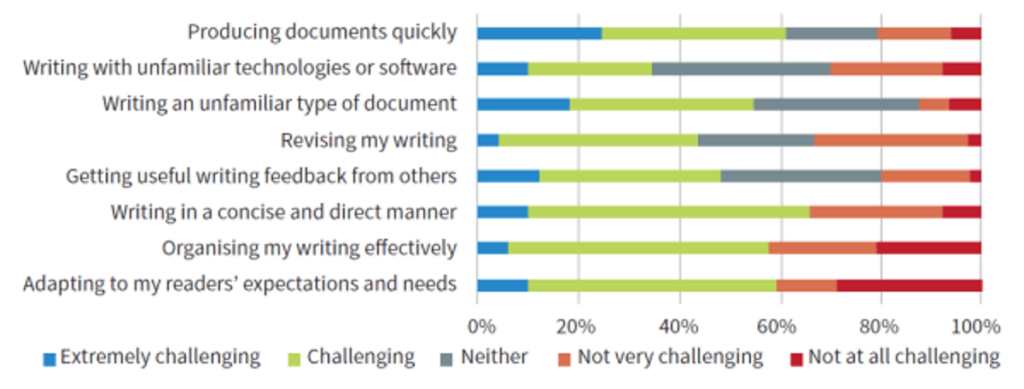
On return to the university setting, post placement, students were asked about their writing during placement. The responses suggest both an individualised experience and some patterns in students’ perceptions including the challenging nature of producing documents quickly, writing in a concise and direct manner and adapting to readers’ expectations and needs (Figure 1).
Figure 1: What students found challenging during placement
The types of writing students typically completed changed between university and placement (Figure 2). As expected, certain writing tasks such as thesis writing and literature reviews, whilst prevalent at university, were not engaged in at all on placement. In turn, regarding other writing tasks such as lesson plans, teaching materials and reflective writing students reported engagement at a similar frequency at both university and on placement. Students also reported on certain writing tasks which are not required very frequently at university, but which are very typical on placement, e.g. formal letters/correspondence and worksheets. This finding points to differences in what students write at university versus what they will be writing in their professional lives.
Figure 2: The types of writing that students engaged in during their time at university and on placement
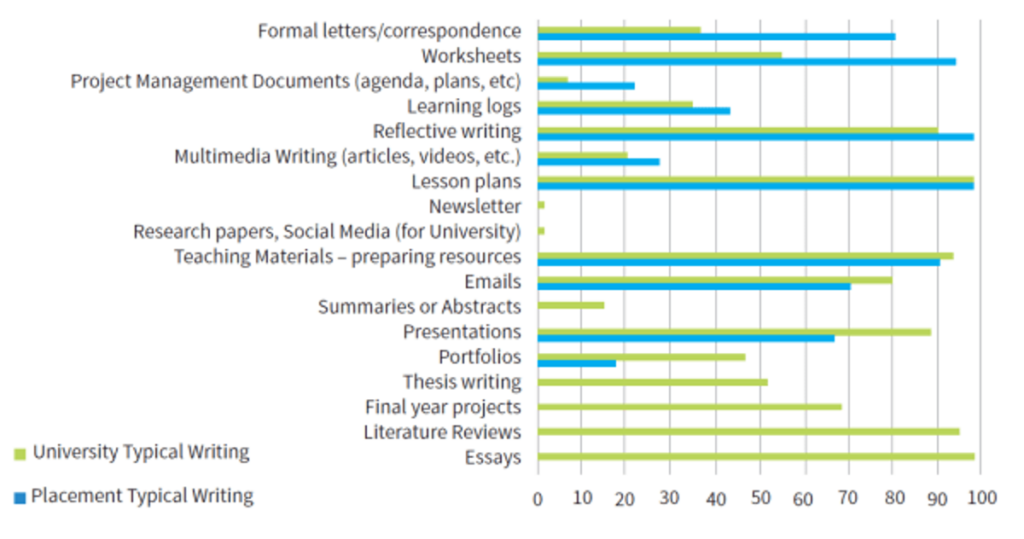
The categories are shown as a percentage of the number of correspondents and arranged based on how large the change between university and placement prevalence there is. Students were also asked to note what three writing tasks they performed the most often (Table 2).
Table 2: Types of writing students complete most often on placement
| University Writing | Placement Writing | |||
| All | Top 3 | All | Top 3 | |
| Dissertation | 4 | 2 | 0 | 0 |
| Emails | 48 | 13 | 36 | 3 |
| Essays | 59 | 56 | 0 | 0 |
| Final year projects | 41 | 9 | 0 | 0 |
| Formal letters/correspondence | 22 | 0 | 41 | 0 |
| Learning logs | 21 | 0 | 22 | 0 |
| Lesson plans | 59 | 54 | 50 | 51 |
| Literature reviews | 57 | 1 | 0 | 0 |
| Multimedia writing (articles, videos, etc.) | 12 | 0 | 41 | 1 |
| Newsletter | 1 | 0 | 0 | 0 |
| Portfolios | 28 | 0 | 9 | 0 |
| Presentations | 53 | 9 | 34 | 4 |
| Project management documents (agenda, plans, etc.) | 4 | 0 | 11 | 1 |
| Reflective writing | 54 | 17 | 50 | 41 |
| Research papers, social media (for University) | 0 | 0 | 0 | 0 |
| Summaries or abstracts | 9 | 0 | 0 | 0 |
| Teaching materials – preparing resources | 56 | 12 | 46 | 30 |
| Thesis writing | 27 | 5 | 0 | 0 |
| Worksheets | 33 | 0 | 48 | 17 |
Students were asked what specific writing tasks they completed both before and on placement. Pre-placement, students (n = 60) mostly reported working on their dissertation on action research project (n=29), assignments and essays (n = 18), lesson plans (n = 8), and stop and think (n=1). During placement, students (n = 51) reported writing reflections (n = 18), lesson plans (n = 10), schemes (n = 8), daily notes or evaluations (n = 4), and Cúntas Míosúil (n = 2). Students also identified a variety of other new writing tasks such as writing letters to parents or student support plans (n = 5).
Finally, the strategies students employed when writing were analysed. First, students were polled on how often they do certain things when writing (Figure 3), which revealed some notable changes in students’ writing process at university and on placement. Overall, students reported that their placement writing was much more collaborative in nature, saying they collaborated with others and used feedback much more often when on placement. Similarly, students reported using templates more often to complete their writing task, which may account for the amount of time spent attending to documents’ conventions such as proper referencing being decreased on placement; this may also be a function of the shift in genres between university and placement writing.
Figure 3:How often students do certain things when writing (100% being always, 75% almost always, etc. through the mean).
Categories are organised in order of largest relative increase during placement to largest decrease e.g. Participating in a collaborative writing group increased on placement the most of all categories, whilst attending to document’s conventions decreased the most on placement.
Figure 3: How often students do certain things when writing (100% being always, 75% almost always, etc. through the mean).
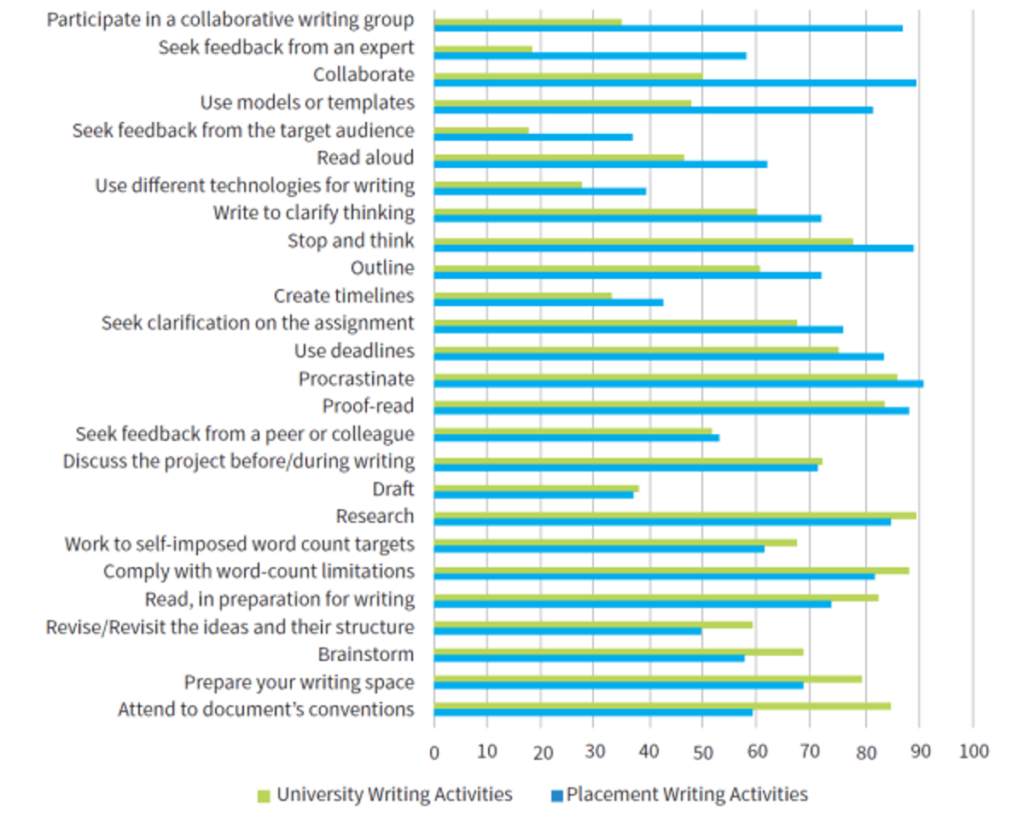
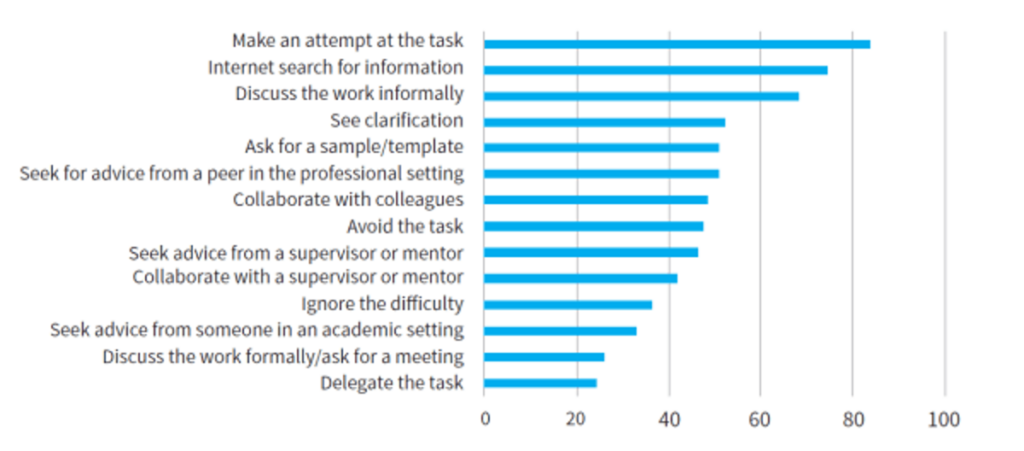
Finally, students were asked what strategies they used to overcome difficulties with their writing during their placement (Figure 4). Students reported a variety of strategies; most often, students reported making an attempt at the task despite the difficulties, but also reported a range of collaborative strategies from discussing the work informally, seeking clarification or advice, and collaborating with their colleagues. Further to the strategies shown in Figure 4, students also employed timelines, brainstorming, and working around key words.
Figure 4: Strategies that students used to overcome difficulties when writing
Discussion
Here we discuss our findings in relation to the three elements of the activity theory framework to support our assertion about the necessity of a deliberate and consistent focus on transfer in higher education programmes.
Assumption 1: ‘meaningful learning and development happen within and as part of multiple and multi-layered activity systems’.
In our findings we can see the influence that the setting and the various actors have on the students’ writing tasks and their writing processes. There is some similarity in terms of what both the university and the placement setting demand in terms of genres; for example, lesson plans, teaching materials/resources, worksheets, emails, learning logs and reflective writing all play a part in the writing that students do both in university and on placement. However, what is possibly more striking (but perhaps not overly surprising) are the differences in terms of the genre demands. In the university, standard texts such as essays, presentations, final year projects, literature reviews and thesis/dissertation writing prevail, whereas they hardly feature in the placement setting. In terms of writing strategies, students remarked that in the placement setting they collaborated more and sought feedback more often. They also used templates more and were less inclined to procrastinate, to research and to attend to writing conventions.
These sorts of shifts are to be expected if we recognise the process and relational nature of transfer, which is dynamic and context dependent. Writing in university is different from writing on placement and/or in a work setting, and successful transfer can occur when students are able to recognise those differences, identify and ascertain the demands of the writing tasks, and adjust their writing behaviour in order to tackle them. As Moore and Morton observed, ‘modes of writing in the professional workplace appear to be of a different order from those generally required in academic domains’ and ‘an important written communication “skill” that needs to be developed in students is the ability to recognise the specific circumstances and constraints that shape any writing episode (purpose, audience, etc.), and to be able to “adapt” their writing to suit such contexts’ (2017: 603). It becomes necessary, then, to provide enough instruction, ‘scaffolding’ and practice for students during their university years to equip them with tools for analysing the factors shaping their writing to be able to produce effective writing in new genres and contexts.
Assumption 2: ‘individual learners have individual breakthroughs via the working through of double binds within those systems’.
Our research suggests that while there was consensus among students about being ready to engage in writing on placement, the types of writing they would be doing on placement and the approaches they would take, they were notably split on how prepared they felt, how much writing they thought they would be doing and if they would have access to help. In turn, what students found difficult during their placement was somewhat individualised. The students, naturally, bring themselves – who they are as students, teachers and writers – to the placement setting, thus making it important to recognise their individual experience of transfer. This reflects Holmes’ ideas around taking a ‘more realistic, and more practical mode of action’, as seen in a ‘graduate identity approach’ to employability (2013: 551). As Holmes notes, ‘graduate employability can be considered as the always-temporary relationship that arises between an individual graduate and the field of employment opportunities, as the graduate engages with those who are “gatekeepers” to those opportunities, particularly those who make selection decisions’ (2013: 550).
While on placement students will have unique experiences as a consequence of which they may learn more about writing and themselves as writers. As part of these experiences students may discover that some of their knowledge and approaches are not optimum for their new setting. The negotiation of new situations, either through the introduction of new ways or the transfer and/or adaption of existing ways could be disruptive, especially if they seem to be in conflict with trusted and reliable existing behaviour. One possible example of this from our data is the need for concision that emerged in the placement setting. Moore and Morton note in their research that ‘[t]he most common feature of workplace writing commented on was the need for brevity and concision. This feature was noted by informants from virtually all the professional areas included in the survey’ (2017: 597-598). In our research, over 60% of students noted that they found ‘writing in a concise and direct manner’ either ‘very challenging’ or ‘challenging’. This is despite the fact that in the academy we often profess that good academic writing is clear and concise; however, students may see our opinion as contrary to the way academic writing operates. Students could interpret academic texts as being long-winded and meandering, and they would be forgiven for thinking that ‘more is more’ in terms of fulfilling word counts. As a result of their placement they may have to reconsider this and other beliefs in order to continue to develop writing approaches which will be a better fit for the professional world.
In addition, as noted previously, students reported that their placement writing was more collaborative in nature, saying they collaborated with others and used feedback more often on placement. This emphasis on collaboration in writing may have been out of step with previous writing demands. In Irish higher education, written tasks especially where they are associated with assessment are frequently high stakes. In a placement setting, writing is generally for other purposes besides assessment and collaboration may be both required and desirable. Moving to a system where one has less direct ‘ownership’ of a text may be unconventional for students. This is not to say that this is necessarily a negatively unsettling experience; on the contrary, students may welcome the opportunity for greater collaboration in their writing. Nevertheless, in our research students did remark on it being different and they did have to negotiate it toward a successful outcome. Introducing more opportunities for reflecting on the differences in the expectations and realities of writing at university and in professional settings could help students negotiate those potentially conflicting demands to be better prepared for the realities of professional writing.
Assumption 3: ‘learners are sufficiently aware of these breakthroughs in these activity systems to remark on them’.
Whilst our students did report some changes to their writing practices during their placements, it is difficult to ascertain from our quantitative data the depth of their awareness of those differences or indeed any potential ‘breakthroughs’. Moore and Morton note that ‘it is difficult, if not in practice impossible, to identify writing requirements of professional areas in any generic sense, and that these are often unique to specific professional areas, organisations, and workplace roles’ (2017: 603). Hence, it is plausible that where students have any success in writing on placement, they will have negotiated unique writing situations which may have been associated with personal breakthroughs for those students. Our students did remark on feeling more confident about their writing, they noted that they had drawn on different approaches, that they noticed that similar and different writing genres and situations prevailed in the university and beyond the university on placement, and that different qualities in terms of writing were required on placement e.g. concision. The fact that they reported these in their answers to the questions indicates some awareness of those changing practices. A complementary analysis of the interview data that explores the depth of such awareness is planned for another publication.
Conclusion
The purpose of this chapter was to explore students’ experience of transfer as a worked example of our assertion that a deliberate focus on transfer of learning beyond the university could be part of the new normal for higher education and could contribute to student success. While the study is limited in terms of the size of the student cohort and the descriptive quantitative data, our initial findings concur with those of other researchers in the field. We agree with Moore and Morton that students benefit from ‘exposure to a range of experiences and tasks that will help them to learn how to “shape” their acquired disciplinary knowledge in distinctive and communicatively appropriate ways … to have them reflect on the contextual and interactional issues that may be at stake in such episodes (Moore and Hough 2005; Moore 2013)’ (2017: 605). We also concur with Hinchliffe and Jolly that there is ‘no simple model of transfer – whether of skills or of knowledge – in the transition of students into graduate employment’ (2011: 581). Furthermore, we see substantial merit in Hager and Hodkinson’s (2009) suggestion, quoted in Hinchliffe and Jolly, that ‘we should cease thinking and writing about “learning transfer” and think instead of learning as becoming, within a transitional process of boundary crossing’ (2011: 635). The notion of boundary crossing itself resonates with the theory of threshold concepts (Meyer and Land, 2006) which as Moore and Anson note, informs writing transfer studies (Moore and Anson, 2016). Interested readers are directed to recent edited collections by Adler-Kassner and Wardle on the topic of threshold concepts and writing studies (2015; 2020).
Our students’ experience of transfer highlighted that they recognised the importance of context, that they could see the necessity and the value of being able to adapt, that they experimented with new approaches that seemed more suited to the ‘beyond the university setting’, that they grew in confidence as they learned and practised these new ways of writing, that they learned about themselves as writers and as colleagues, and that they identified the social and collaborative nature of writing. Previous work by Farrell and Tighe-Mooney noted the idea of ‘a transfer continuum rather than merely a step or bridge from one context to another’ where a focus on transfer could be ‘an element of transformative learning that is nurtured in our … institutions but which continues long after the formal education process ends’ (2015: 37). Writing beyond the university into professional settings will be an individual journey but it need not be one which is taken alone; collaboration was highlighted as important for the writers in our research and Wenger and colleagues’ work on communities of practice is drawn on explicitly in writing transfer research (2002). In turn students can develop enabling practices that emphasise that promote writing transfer (Yancey, Robertson and Taczak, 2014). We hope that a more explicit and integrated focus on transfer within higher education can help students to achieve success within that setting and to collaboratively develop practices and processes that they can employ in their writing beyond the university.
Acknowledgement: The authors acknowledge support for this research from Elon University (North Carolina, United States) through the Writing Beyond the University Research Seminar. We also acknowledge the feedback and encouragement of the reviewers and publication editors.
References
Adler-Kassner, L. and Wardle, E. (2015). Naming what we know: Threshold concepts of writing studies.
Logan: Utah State University Press.
Adler-Kassner, L. and Wardle, E. (2020). (Re)Considering What We Know: Learning Thresholds in Writing, Composition, Rhetoric, and Literacy. Logan: Utah State University Press.
Anson, C. M. and Moore, J. L. (eds.). (2016). Critical Transitions: Writing and the Question of Transfer. The WAC Clearinghouse; University Press of Colorado. https://doi.org/10.37514/PER-B.2016.0797.
Clarke, M. (2018). Rethinking graduate employability: the role of capital, individual attributes and context. Studies in Higher Education, 43:11, 1923-1937, DOI: 10.1080/03075079.2017.1294152.
Department of Education and Skills. (2016). Ireland’s National Skills Strategy 2025. https://www.education.ie/en/Publications/Policy-Reports/pub_national_skills_strategy_2025.pdf.
Elon University. Elon Statement on Writing Transfer. (2015). Retrieved from http://www.centerforengagedlearning.org/elon-statement-on-writing-transfer/.
Elon University. Writing Beyond the University Research Seminar 2019-2021. https://www.centerforengagedlearning.org/research-seminars/writing-beyond-the-university/.
Elon University. Writing Beyond the University: Preparing Lifelong Learners for Lifewide Writing, under contract with Center for Engaged Learning Open Access Series, projected publication date summer 2022 (temporary citation).
Engestrom, Y. (1987). Learning by expanding. Cambridge: Cambridge UP.
European Commission. (2020). Communication on a European Skills Agenda for Sustainable Competitiveness, Social Fairness and Resilience.
Farrell, A. and Tighe-Mooney, S. (2015). Recall, Recognise, Re-Invent: The Value of Facilitating Writing Transfer in the Writing Centre Setting. Journal of Academic Writing, 5 (2). pp. 29-42. ISSN 2225-8973.
Freudenberg, B., Brimble, M. and Cameron, C. (2011). WIL and Generic Skill Development: The Development of Business Students’ Generic Skills Through Work-integrated Learning. Asia-Pacific Journal of Cooperative Education 12 (2): 79-93.
Grijalva, R.A. (2016). Minding the gap: Writing-related learning in/across/within multiple activity systems. Anson, C. M. and Moore, J. L. (eds.). (2016). Critical Transitions: Writing and the Question of Transfer. The WAC Clearinghouse; University Press of Colorado. https://doi.org/10.37514/PER-B.2016.0797.
Hall, K., Murphy, R., Rutherford, V., and Ní Áingléis, B. (2018). School Placement in Initial Teacher Education [online]. Available at: School Placement in Initial Teacher Education – Teaching …
Higher Education Authority. (2011). National strategy for higher education to 2030. Dublin: HEA https://hea.ie/assets/uploads/2017/06/National-Strategy-for-Higher-Education-2030.pdf.
Higher Education Authority. (2018). System Performance Framework 2018-2020. https://hea.ie/assets/uploads/2018/01/higher-education-system-performance-framework-2018-2020.pdf.
Higher Education Authority. (2020). Human Capital Initiative. https://hea.ie/skills-engagement/human-capital-initiative/.
Hinchliffe, G. W., and Jolly, A. (2011) Graduate Identity and Employability. British Educational Research Journal 37 (4): 563-584, DOI: 10.1080/01411926.2010.482200.
Holmes, L. (2013). Competing Perspectives on Graduate Employability: Possession, Position or Process? Studies in Higher Education 38 (4): 538-554, DOI: 10.1080/03075079.2011.587140.
Leont’ev, A. (1978). Activity, Consciousness, and Personality. Englewood Cliffs: Prentice Hall.
McLennan, B., and Keating, S. (2008). ‘Work-integrated learning (WIL) in Australian Universities: The Challenges of Mainstreaming WIL.’ ALTC NAGCAS National Symposium, Citeseer.
Meyer, J. H. F. and Land, R. (2006). Threshold concepts and troublesome knowledge: An introduction. In Meyer, J. H. F. and Land, R. (eds.), Overcoming barriers to student understanding: Threshold concepts and troublesome knowledge (pp. 3-18). London: Routledge.
Moore, T. (2013). Critical Thinking: Seven Definitions in Search of a Concept. Studies in Higher Education 38 (4): 506-22.
Moore, T., and Hough, B. (2005). “The Perils of Skills: Towards a Model of Integrating Graduate Attributes into the Disciplines.” In Proceedings of the Language and Academic Skills Conference, edited by S. Milnes, 1-18. Canberra: Australia National University.
Moore, T., and Morton, J. (2017). The Myth of job Readiness? Written Communication, Employability, and the ‘Skills Gap’ in Higher Education. Studies in Higher Education 42 (3): 1-19, DOI: 10.1080/03075079.2015.1067602.
National Forum for the Enhancement of Teaching and Learning in Higher Education. (2019). Towards a National Understanding of Student Success, in teachingandlearning.ie, https://www.teachingandlearning.ie/publication/towards-a-national-understanding-of-student-success/.
National Forum for the Enhancement of Teaching and Learning in Higher Education. (2019). Understanding and Enabling Student Success in Irish Higher Education in teachingandlearning.ie, https://www.teachingandlearning.ie/publication/understanding-and-enabling-student-success-in-irish-higher-education/.
Orrell, J. (2004). “Work-integrated Learning Programmes: Management and Educational Quality.” Proceedings of the Australian Universities Quality Forum, Victoria, Victoria University.
Roozen, K. (2008). Journalism, poetry, stand-up comedy, and academic literacy: Mapping the interplay of curricular and extracurricular literate activities. Journal of Basic Writing 27(1), 5-34.
The Teaching Council. (2013). Guidelines on School Placement (online). Available at: Guidelines on School Placement – Teaching Council.
Vygotsky, L.S. (2012). Thought and Language. Cambridge: MIT Press.
Wardle, E. and Clement, N.M. (2016). Double binds and consequential transitions: Considering matters of identity during moments of rhetorical challenge. In Anson, C. M. and Moore, J. L. (eds.). (2016). Critical Transitions: Writing and the Question of Transfer. The WAC Clearinghouse; University Press of Colorado. https://doi.org/10.37514/PER-B.2016.0797.
Wenger, E., McDermott, R. and Snyder, W. M. (2002). Cultivating communities of practice: A guide to managing knowledge. Boston: Harvard Business School Press.
Yancey, K., Robertson, L. and Taczak, K. (2014). Writing Across Contexts: Transfer, Composition, and Sites of Writing. Utah State University Press.
Appendix 1
Note on school placement as part of the BEd programme
Students are placed in a variety of settings during school placement including mainstream classes, DEIS schools (Delivering Equality of Opportunity In Schools), Gaelscoileanna (schools which operate through the Irish language) and Special Educational Needs schools. Over the course of the degree programme, they complete 36 weeks of placement with a stipulation from the Teaching Council (the professional standards body for the teaching profession) that one ten week block must be completed in the final half of their degree.
A gradual release of responsibility model is used over the four years of the BEd. In the first year of the degree, students observe an infant class and teach three lessons a day. In their second year, students are placed in pairs where they plan and teach collaboratively. During year three of the BEd students plan and teach for the entire school day. On their final 4th year placement, students plan using planning documents set out by the National Induction programme (a support programme for newly qualified teachers). This placement gives students an opportunity to engage completely in the life of the school. They are placed in a class from 1st class to 6th class (pupils aged between 7 and 12 years approximately).